
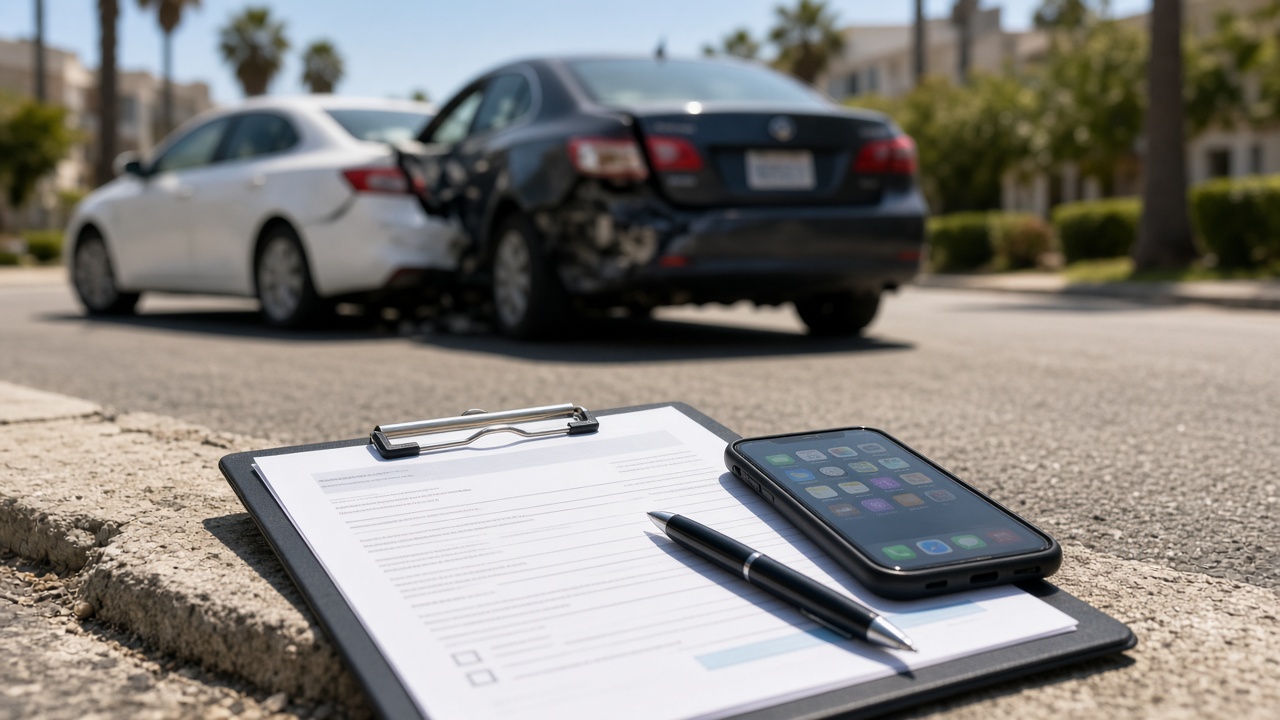
Underinsured motorist claim California rules matter when the other driver’s low policy limits can’t cover your injuries. Imagine you are rear-ended on the 405 near Brookhurst, or T-boned at an intersection in Riverside. You need an MRI, physical therapy, maybe surgery. You miss weeks of work. Then the other driver’s insurance company calls with what sounds like good news: they will pay their “policy limits.” The problem? Their policy limit is $30,000, and your losses are already far beyond that.
The good news: the other driver’s policy is not always the end of the road. Here’s how California’s minimum insurance rules work in 2026, what underinsured motorist coverage is, and what to do next.
California’s Minimum Car Insurance: What Changed and What’s Next
For decades, California’s minimum liability insurance was just $15,000 per person, $30,000 per accident and $5,000 for property damage. Senate Bill 1107 changed that. Starting January 1, 2025, the minimums for a standard auto policy rose to 30/60/15:
- $30,000 for injury or death of one person
- $60,000 for injury or death of two or more people in one accident
- $15,000 for damage to other people’s property
California’s Insurance Commissioner called it the first update to the state’s financial responsibility law in 56 years. And SB 1107 already schedules another increase: on January 1, 2035, the minimums rise to $50,000 / $100,000 / $25,000.
What “30/60” really means for injured people
The $60,000 “per accident” limit is shared. If a minimum-coverage driver injures you and two passengers, the three of you may have to split $60,000, with no more than $30,000 to any one person. The at-fault driver is still personally responsible beyond the limits, but collecting from an individual is often difficult.
Why the Minimum Often Isn’t Enough
A serious injury can still blow past $30,000 once you add emergency care, imaging, therapy, lost wages and future treatment. And our area sees a lot of injury crashes. According to the Southern California Association of Governments (SCAG), using state crash data:
- In Orange County, about 16,477 people are injured and 214 people die in traffic collisions each year.
- In Riverside County, about 14,185 people are injured and 314 people die each year.
Some at-fault drivers have no insurance at all. The Insurance Research Council estimated that 20.4% of California drivers were uninsured in 2023, the eighth-highest rate in the country.
Underinsured Motorist Claim California: Your Own Policy May Fill the Gap
Underinsured motorist coverage is part of your auto policy. It can pay for your injuries when the at-fault driver’s insurance is too small. In California, it is offered together with uninsured motorist coverage, often listed as “UM/UIM” on your declarations page.
How UIM works in California
Under California Insurance Code section 11580.2, a vehicle is “underinsured” when its liability limits are lower than your own UM/UIM limits. Your UIM coverage then pays up to your limit, minus what the at-fault driver’s insurance paid.
Example: You carry $100,000 in UIM coverage. The at-fault driver has a $30,000 policy and pays it in full. If your damages are higher, your UIM coverage may pay up to an additional $70,000.
The catch many people miss: if your UIM limit is the same as or lower than the other driver’s liability limit, there may be no UIM claim at all. If you carry 30/60 UIM and the other driver has a 30/60 policy, their car is not legally “underinsured” compared to your coverage.
Two rules that can make or break a UIM claim
- The at-fault driver’s limits generally must be exhausted first. UIM typically doesn’t apply until the other driver’s bodily injury limits are paid through a settlement or judgment, and you give your insurer proof of payment.
- Don’t settle without your insurer’s written consent. Under California law, UM/UIM coverage may not apply if you settle with the at-fault driver without your own insurer’s written consent.
Disputes go to arbitration, and deadlines are strict
If you and your insurer can’t agree on what your UIM claim is worth, the dispute goes to arbitration before a single neutral arbitrator, not a jury. And within two years of the accident, you generally must file a lawsuit against the at-fault driver, reach an agreement with your insurer, or formally demand arbitration by certified mail.
Did you turn this coverage down?
Insurers must offer UM/UIM coverage; you can only reject it, or buy lower limits, in a signed writing. Check your declarations page or ask your agent.
Other Possible Sources of Compensation
Depending on your situation, help may also come from:
- Medical payments (MedPay) coverage on your own policy, which can help pay medical bills regardless of who was at fault. (Note: some policies reduce UM/UIM payments by what MedPay already paid.)
- Your health insurance, which may cover treatment while the claim is pending (and may later seek reimbursement).
- Other responsible parties, such as the driver’s employer if they were working, a second driver, or a rideshare company’s policy. See our guide on how rideshare insurance works after an accident.
What to Do After a Crash With an Underinsured Driver
- Get medical care right away and follow your treatment plan.
- Call the police and get the report number. Photograph the other driver’s license, insurance card and plate.
- Notify your own insurance company promptly. Ask about your UM/UIM and MedPay limits, and request your declarations page.
- Don’t accept a policy-limits offer or sign a release yet. First make sure your UIM insurer has given written consent.
- Track every loss. Keep medical bills, pay stubs showing missed work, and a simple pain journal.
- Be careful what you say to adjusters. In a UIM claim, even your own insurer is on the other side. Our article on dealing with insurance adjusters explains why.
- Watch the two-year deadlines. Most injury lawsuits and UIM claims have two-year requirements. Learn more about the statute of limitations for car accidents in California.
- If it was a hit-and-run, report it to police or the CHP within 24 hours. Uninsured motorist coverage may apply, but the law also requires a sworn statement to your insurer within 30 days. Our hit-and-run guide walks through the steps.
A Quick Coverage Check Before Your Next Renewal
You can’t control other drivers’ insurance, but you can control your own UM/UIM limits. The California Department of Insurance notes drivers may want higher limits than the law requires, so review your UM/UIM and MedPay limits at your next renewal.
Frequently Asked Questions
What is the minimum car insurance in California in 2026?
For a standard auto policy, the minimum liability coverage is $30,000 for injury or death of one person, $60,000 for injury or death of two or more people, and $15,000 for property damage. These limits took effect January 1, 2025 under SB 1107.
When will California’s minimum insurance go up again?
Under SB 1107, the minimums are scheduled to increase on January 1, 2035 to $50,000 per person, $100,000 per accident and $25,000 for property damage.
What if the at-fault driver only has $30,000 in coverage and my damages are higher?
You may have an underinsured motorist (UIM) claim through your own policy if your UIM limits are higher than the other driver’s limits. UIM pays up to your limit, minus what the other driver’s insurer paid.
Do I need my insurance company’s permission to accept the other driver’s policy limits?
In most cases, you should get your UIM insurer’s written consent before settling with the at-fault driver. Settling without consent can jeopardize your UIM coverage under California law.
How long do I have to make an underinsured motorist claim in California?
Generally, within two years of the accident you must file a lawsuit against the at-fault driver, reach an agreement with your insurer, or formally demand arbitration by certified mail. Talk to a lawyer well before that deadline.
What if the driver who hit me had no insurance at all?
Your uninsured motorist coverage may help pay for your injuries. If you were the one without insurance, different rules apply; see our article on what happens if you don’t have car insurance and you’re hit by another driver.
Not Sure Whether the Other Driver’s Insurance Is Enough? Let’s Talk
At Tafreshi Law Group, we treat people, not just cases. We’ll review the other driver’s coverage and your own policy, explain your options in plain English, and help you avoid mistakes that can cost you a UIM claim. Hablamos español.
Consultations are free, and we work on a contingency basis: you pay no attorney’s fee unless we recover money for you. We’ll explain exactly how fees and case costs work before you sign anything.
- Fountain Valley office: 18837 Brookhurst St, Ste 207, Fountain Valley, CA 92708. Call (949) 989-2511
- Riverside office: 4121 Brockton Ave, Ste 101, Riverside, CA 92501. Call (951) 583-1900
You can also contact us online or visit our Riverside car accident lawyer and Fountain Valley personal injury pages.
Disclaimer: This article is for general information only and is not legal advice. Reading it does not create an attorney-client relationship. Insurance policies differ, and the terms of your own policy control. Every case is different, and past results do not guarantee a similar outcome. Information is current as of October 2026.
Sources
- SB 1107 (Dodd, Ch. 717, Stats. 2022), bill text and digest: https://leginfo.legislature.ca.gov/faces/billNavClient.xhtml?bill_id=202120220SB1107
- California Department of Insurance, Bulletin 2023-1 re: SB 1107 (“first update … in 56 years”): https://www.insurance.ca.gov/0250-insurers/0300-insurers/0200-bulletins/bulletin-notices-commiss-opinion/upload/bulletin-2023-1-re-sb-1107-final-003.pdf
- Assembly Insurance Committee analysis summarizing SB 1107 and the 2035 increase to 50/100/25: https://ains.assembly.ca.gov/system/files/2025-07/sb-371-cabaldon-assembly-insurance-analysis_0.pdf
- California DMV, Insurance Requirements (30/60/15): https://www.dmv.ca.gov/portal/vehicle-registration/insurance-requirements/
- California Department of Insurance, Automobile Insurance consumer guide (UM/UIM waiver, MedPay, higher limits): https://www.insurance.ca.gov/01-consumers/105-type/95-guides/01-auto/upload/IG-Auto-Insurance-Updated-020525.pdf
- California Insurance Code § 11580.2 (UM/UIM definitions, offset, exhaustion, consent, arbitration, two-year rule, hit-and-run reporting): https://law.justia.com/codes/california/code-ins/division-2/part-3/chapter-1/article-2/section-11580-2/
- Insurance Information Institute, “Facts + Statistics: Uninsured motorists” (IRC 2023 estimate, California 20.4%): https://www.iii.org/fact-statistic/facts-statistics-uninsured-motorists
- SCAG, Transportation Safety Factsheet – Orange County: https://scag.ca.gov/sites/default/files/2025-09/Safety_Factsheet_Orange.pdf
- SCAG, Transportation Safety Factsheet – Riverside County: https://scag.ca.gov/sites/default/files/2025-09/Safety_Factsheet_Riverside.pdf
- California Code of Civil Procedure § 335.1 (two-year deadline): https://leginfo.legislature.ca.gov/faces/codes_displaySection.xhtml?lawCode=CCP§ionNum=335.1

2 Comments
[…] Many drivers carry only California’s minimum liability coverage of $30,000 per person and $60,000 per accident for injuries. That may not cover a serious pedestrian injury. Your own auto policy’s uninsured/underinsured motorist coverage may help even though you were on foot. Check your policy and see how the 30/60/15 limits affect your claim. […]
[…] little or no insurance, your own uninsured or underinsured motorist coverage may help. Read about minimum insurance limits in California, or see our Orange County car accident […]